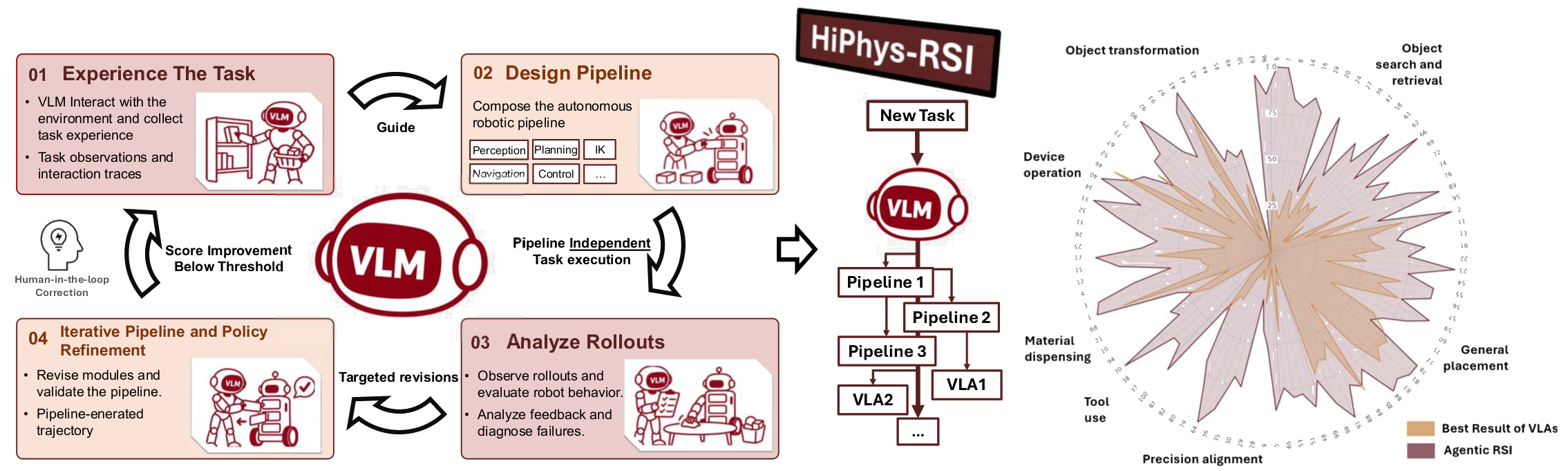

HiPhys-RSI overview. Left: the agent acquires task experience and refines executable pipelines on training instances. Middle: at inference time it routes each task to a pipeline or a VLA policy. Right: per-task scores of our system compared with the best VLA.
2026 BEHAVIOR Challenge, 100 tasks, hidden test instances, official evaluator.
Improvement lives in code and structured knowledge, not in model weights, so it carries over to the next task.
The agent reads the task specification and demonstrations, then controls the robot directly on a few training instances to learn which tools are needed and which observable conditions mean success.
Perception, navigation, planning, IK and control modules are composed into one autonomous program with state tracking, progress checks and conditional branches.
Execution logs and VLM-based video analysis show where the physical outcome diverged from the plan, even when every tool call “succeeded”.
Targeted revisions change tool choice, parameters, execution order or recovery logic. The loop continues until the score stops improving.
Finished pipelines become callable tools for new tasks, giving hierarchical composition: pipelines call reusable procedures, which call low-level skills.
Each pipeline and VLA has a card recording its capabilities, historical success and known corner cases. The agent routes every task to the best-suited component.
Trajectories from the pipelines fine-tune VLAs, and the improved policies return to the tool library, linking scaling by structure with scaling by data.
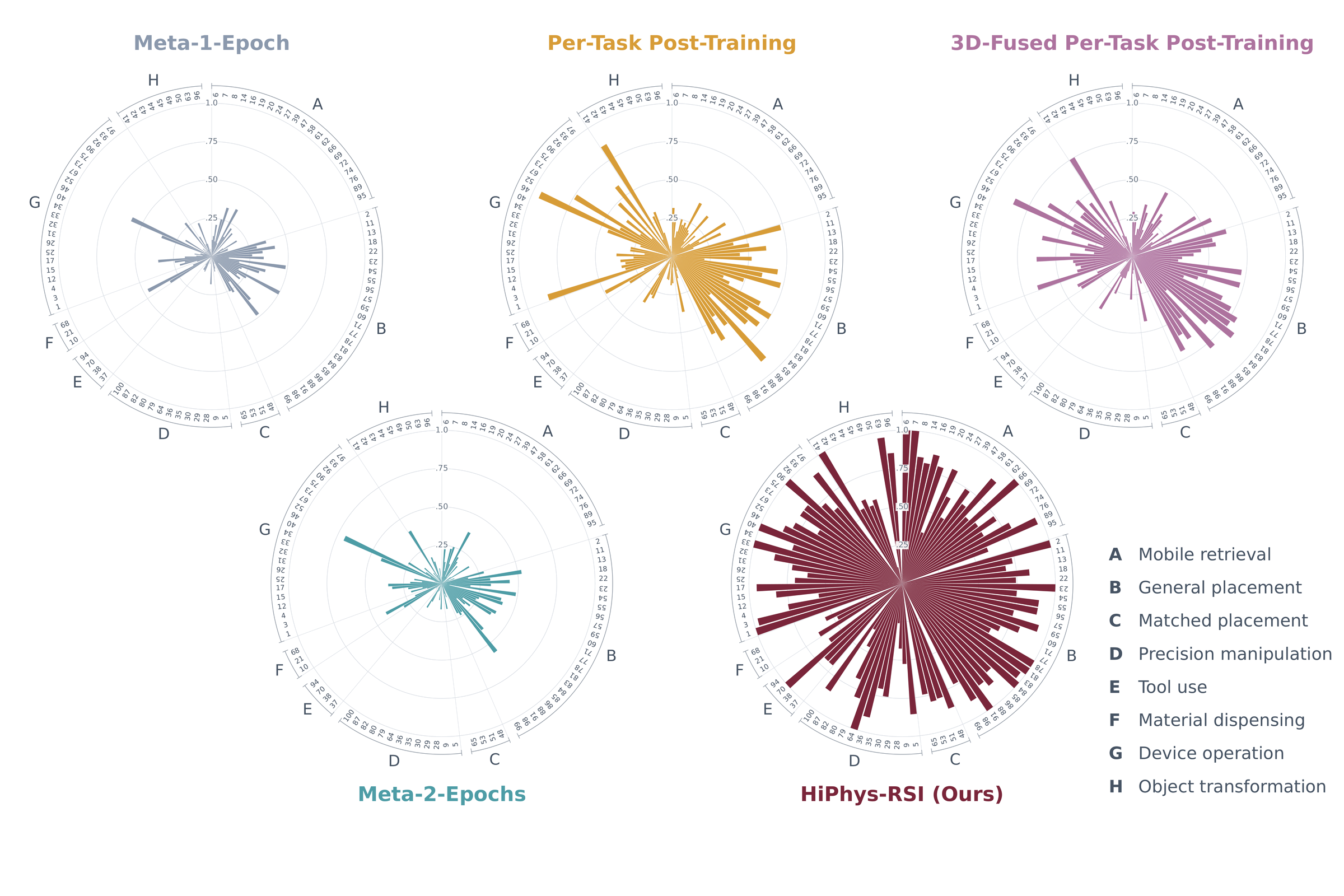
Compared with four VLA variants built on the 2025 first-place π0.5-based solution: meta-training on all 100 tasks for one or two epochs, per-task post-training, and 3D-fused per-task post-training.

Each radial bar is one task, grouped into eight categories from mobile retrieval to object transformation. More VLA training raises individual scores but leaves whole categories empty; HiPhys-RSI fills the circle.
Rapid early gains come from composing capabilities; later gains come as RSI discovers new strategies. Most tasks converge quickly, and a long tail needs real exploration.
Placement, articulation and object-loss failures of the VLA baseline largely disappear. What remains is dominated by grasping and by execution-budget limits such as timeouts.
General placement and tool use need the most iterations; device operation needs the fewest.
After the initial saturation, later gains come from strategies that appear nowhere in the demonstrations. They change how a task is approached, not just how it is tuned.
Compared with the VLA baseline, placement, articulation and object-loss failures largely disappear. The remaining failures are dominated by grasping and by execution-budget limits such as timeouts.
Pipelines were developed without access to the hidden test instances. Most tasks keep comparable scores on the hidden evaluation; the largest drops occur in search-heavy tasks with occluded objects.
Through agent proposals and human-guided refinement, the pipelines adapt contact points, object configuration, action order and placement geometry to the scene.
A self-improving agent optimizing against a benchmark invites the question. These are the controls we used, and the gray-zone behaviours we found and report ourselves.
Each pipeline was built and refined on a fixed set of 10 training instances per task. The hidden test instances stayed inaccessible throughout development.
Scores come from the official evaluator with matched task-execution budgets across methods, so comparisons with VLA baselines are like for like.
The 0.683 Q-score and 48.2% success rate were produced by the organizers on the hidden test instances and appear on the verified leaderboard.
The coding agent and its VLM backbone are never trained. Pipeline improvements are stored as executable code, so every behaviour can be read and inspected.
Most tasks score somewhat lower on the hidden evaluation than on development instances, but most of these drops stay below 0.2 Q, and several tasks hold or improve. The largest drops come from search-heavy tasks, where objects hidden in occluded places use up the time budget. Overall, the results indicate generalization across instances.
Under strong optimization, success predicates and partial rewards can stop tracking what a task intends. We looked for this and report two cases from our own analysis.
The agent formed three separate pairs of logs instead of one woodpile. This satisfies the evaluator's condition that each log touches another, but not the intended stacking goal.
The agent diced food inside the refrigerator, earning partial credit while the later transfer-to-bowl goals stayed unmet. The evaluator correctly records incomplete progress, and cutting in place can be a valid intermediate step, but it may also reflect a pull toward easy partial credit.
Grasping a pan by its rim or tipping a sprayer before grasping (see the case studies above) differs from the demonstrations but achieves the task as intended. Deviation from demonstrations alone does not establish hacking.
Stronger systems expose gaps in task specifications; shortcuts we discover are reported so that evaluation criteria can evolve alongside the systems optimized against them.
The tech report is in preparation; this entry will be updated on release.
@techreport{hiphysrsi2026,
title = {Scaling by Structure: What Forms Can Scaling Take in Embodied AI?},
author = {Huawei Noah's Ark Lab EAI Team},
year = {2026},
note = {1st place, 2026 BEHAVIOR Challenge}
}Structured knowledge built and refined by coding agents is a strong, complementary way to scale embodied intelligence. Next, we will close the real–sim–real loop.